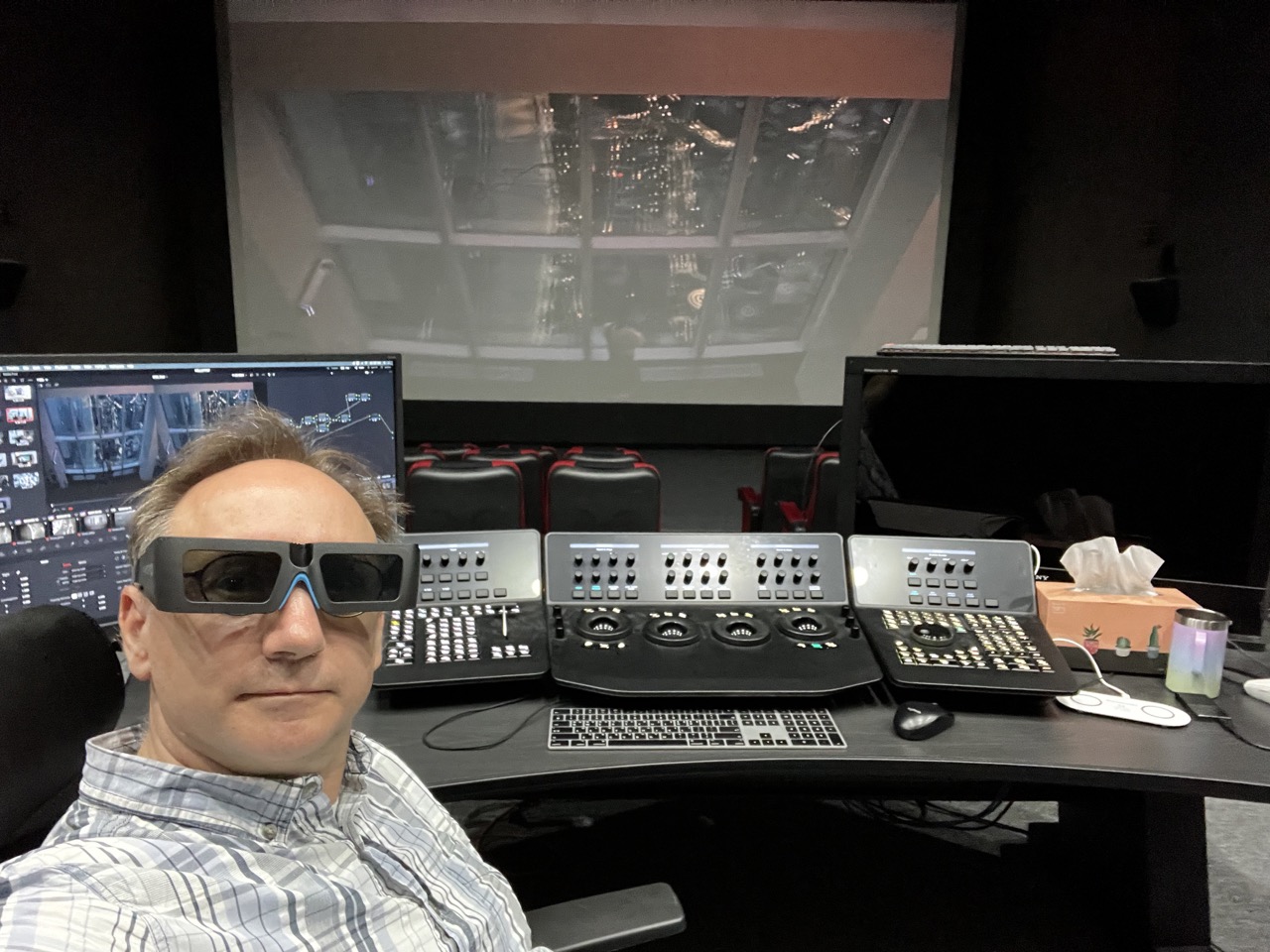
Alaric Hamacher — From Filmmaking to Spatial Media
Alaric Hamacher — From Filmmaking to Spatial Media
Award-Winning Filmmaker · Cinematographer · Professor · Stereoscopic 3D Specialist · Holographer · Spatial Media Researcher
Prof. Alaric Hamacher is a filmmaker, cinematographer and spatial-media researcher working at the intersection of cinema, stereoscopic 3D, extended reality, digital holography and virtual production.
Based at Kwangwoon University in Seoul, his work approaches emerging imaging technologies from an unusual perspective: that of a filmmaker.
For Hamacher, the development of XR and spatial imaging is not simply a technological transition. It is part of the continuing evolution of the moving image.
The question is not only how a new imaging technology works, but what images we can create with it.
From Cinema to the Spatial Image
Hamacher’s career in moving images began long before the emergence of today’s XR technologies.
His professional background in filmmaking and cinematography developed into an early interest in stereoscopic imaging and the relationship between cameras, perception and three-dimensional space.
Stereoscopic cinema became a bridge between conventional filmmaking and a much broader field of spatial imaging.
A conventional camera records the world from one viewpoint.
Stereoscopic cinematography records two viewpoints and recreates binocular depth.
XR surrounds the viewer with imagery.
Volumetric capture reconstructs scenes in three dimensions.
Light-field and holographic technologies can provide multiple viewpoints as the observer moves.
These developments form a technological and creative continuum:
Cinema → Stereoscopic 3D → Immersive Media → XR → Spatial Video → Volumetric Imaging → Light Fields → Digital Holography
Understanding the relationships between these forms of imaging has become a central theme of Hamacher’s work.
Award-Winning Filmmaker and Stereoscopic 3D Specialist
Before spatial computing became a widely used term, Hamacher was already working professionally with stereoscopic cinema and 3D filmmaking.
His work combines the practical disciplines of filmmaking — camera placement, lenses, composition, movement, lighting and storytelling — with the particular perceptual and geometrical requirements of stereoscopic images.
His international work in stereoscopic and immersive media has received recognition including a Lumiere Award.
This experience continues to influence his research today.
Spatial images cannot be understood only as data.
They are also images created for human perception.
Explore Stereoscopic 3D Research and Projects →
Explore Stereoscopic 3D Technical Resources →
Digital Holography
Hamacher’s work subsequently expanded from stereoscopic imaging into digital holography and full-parallax spatial images.
His holographic work investigates how techniques from photography, cinematography and three-dimensional reconstruction can be used to create images in which perspective changes naturally as the observer moves.
One of his best-known holographic works is Blue Girl, a full-parallax digital holographic portrait that has been exhibited internationally and recognized in the field of holographic imaging.
His research has also investigated how consumer imaging technology can make holographic production more accessible.
This includes a workflow combining iPhone photography and depth information, three-dimensional reconstruction, Blender and digital holographic printing.
The work demonstrates an important principle behind his research:
Sophisticated spatial images do not necessarily require entirely new forms of image creation. Existing photographic and cinematic techniques can be extended into new spatial media.
Digital Holography at Kwangwoon University →
Digital Holography Technical Resources →
XR and Spatial Media
At Kwangwoon University, Hamacher’s research increasingly connects technologies that are often considered separate disciplines.
These include:
- Extended Reality (XR)
- Virtual Reality (VR)
- Stereoscopic 3D
- Spatial Video
- Digital Holography
- Volumetric Capture
- Photogrammetry
- Gaussian Splatting
- Light-Field Imaging
- Glasses-Free 3D Displays
- Computational Imaging
- Virtual Production
The common element is the spatial image.
Instead of asking whether a technology belongs to cinema, VR, computer graphics or holography, the research investigates how spatial information can move between capture, representation, computation and display.
This approach is at the core of the XR & Spatial Media Lab at Kwangwoon University.
Research Through Making
A central principle of Hamacher’s work is that emerging media technologies need to be investigated through practical image creation.
Research therefore combines theoretical and technical investigation with experiments, filmmaking, software development, camera systems, display technologies and actual spatial-media production.
This approach also connects academic research with professional production.
Through D.KE, emerging technologies are applied to professional virtual production, broadcast production, technology integration and training.
Virtual Production and Professional Services at D.KE →
Open Knowledge
Hamacher also develops SpatialMedia.dev, an open technical knowledge platform dedicated to understanding and creating spatial media.
The platform documents technologies, experiments and production workflows in areas including stereoscopic 3D, VR180, digital holography, computational imaging and spatial-media production.
Its purpose is to connect academic research with practical, reproducible knowledge that can be used by filmmakers, researchers, students and developers.
Filmmaking as a Foundation for Spatial Media
The technologies used to create moving images continue to change, but many of the fundamental questions remain surprisingly consistent.
Where is the camera?
What does the viewer see?
How is space represented?
How does movement change the image?
And how can technology be transformed into a visual language?
For Alaric Hamacher, spatial media represents a continuation of filmmaking rather than its replacement.
From cinema and stereoscopic 3D to XR, volumetric imaging and digital holography, the objective remains the same:
to create images that communicate through space.
Prof. Alaric Hamacher
Award-Winning Filmmaker · Cinematographer · Professor · Stereoscopic 3D Specialist · Holographer · Spatial Media Researcher
Kwangwoon University
Seoul, Republic of Korea